A DFGPass to balance the tree structure. More...
#include <BalanceTree.hpp>
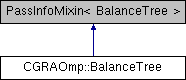
Inheritance diagram for CGRAOmp::BalanceTree:
Public Member Functions | |
| bool | run (CGRADFG &G, Loop &L, FunctionAnalysisManager &FAM, LoopAnalysisManager &LAM, LoopStandardAnalysisResults &AR) |
| Apply tree height reduction for a given DFG. More... | |
Private Types | |
| using | EdgeListTy = SmallVector< DFGEdge *, 10U > |
Private Member Functions | |
| void | initWeight (CGRADFG &G) |
| Initialize the graph weight. More... | |
| SmallVector< ComputeNode * > | findRootCandidates (CGRADFG &G) |
| find candidates for root node More... | |
| void | toBalanced (CGRADFG &G, ComputeNode *Root) |
| Balance the graph for a given root node. More... | |
Static Private Member Functions | |
| static int | getOperatorPrecedence (ComputeNode *N) |
| Function to obtain the precedence for a given ComputeNode. More... | |
Private Attributes | |
| DenseMap< DFGNode *, int > | weight |
| DenseMap< DFGNode *, bool > | visited |
| SmallPtrSet< DFGNode *, 10 > | candidate_set |
| bool | changed |
Static Private Attributes | |
| static std::map< int, int > | OperatorPrecedence |
| map to decode operator precedence More... | |
Detailed Description
A DFGPass to balance the tree structure.
This optimization is based on algorithm proposed in [1].
- See also
- [1] Coons, Katherine Elizabeth, et al. Optimal huffman tree-height reduction for instruction-level parallelism. Computer Science Department, University of Texas at Austin, 2008.
Member Typedef Documentation
◆ EdgeListTy
|
private |
Member Function Documentation
◆ findRootCandidates()
|
private |
find candidates for root node
- Parameters
-
G Data flow graph to be balanced
- Returns
- SmallVector<ComputeNode*> a list of found candidates
◆ getOperatorPrecedence()
|
inlinestaticprivate |
Function to obtain the precedence for a given ComputeNode.
- Parameters
-
N the computational node
- Returns
- It returns integer of precedence level
◆ initWeight()
|
private |
Initialize the graph weight.
- Parameters
-
G Data flow graph to be balanced
◆ run()
| bool BalanceTree::run | ( | CGRADFG & | G, |
| Loop & | L, | ||
| FunctionAnalysisManager & | FAM, | ||
| LoopAnalysisManager & | LAM, | ||
| LoopStandardAnalysisResults & | AR | ||
| ) |
Apply tree height reduction for a given DFG.
- Parameters
-
G Data flow graph (DFG) L Loop associated with the DFGs FAM FunctionAnalysisManager to access analysis results LAM LoopAnalysisManager to access analysis results AR LoopStandardAnalysisResults
- Returns
- It returns true if DFG G is changed
- Otherwise, it returns false
◆ toBalanced()
|
private |
Balance the graph for a given root node.
- Parameters
-
G Data flow graph to be balanced Root Root node
Member Data Documentation
◆ candidate_set
|
private |
◆ changed
|
private |
◆ OperatorPrecedence
|
staticprivate |
map to decode operator precedence
- key: Opcode of llvm::Instruction
- value: the level of precedence (int)
It is a similar setting to precedence table of clang But the lower level means the higher priority
- See also
- clang/Basic/OperatorPrecedence.h
◆ visited
|
private |
◆ weight
|
private |
The documentation for this class was generated from the following files:
- include/BalanceTree.hpp
- src/Passes/CGRAOmpDFGPass/BalanceTree.cpp